Featured

Physical Characteristics

“It will be convenient for me to describe the Florida Seminole as they present themselves, first as individuals, and next as members of a society. know it is impossible to separate, really, the individual as such from the individual as a member of society; nevertheless, there is the man as we see him, having certain characteristics which we call personal, or his own, wheresoever derived, having a certain physique and certain distinguishing physical qualities. As such I will first attempt to describe the Seminole. Then we shall be able the better to look at him as he is in his relations with his fellows in the family, in the community, or in any of the forms of the social life of his tribe.”

Clay MacCauley

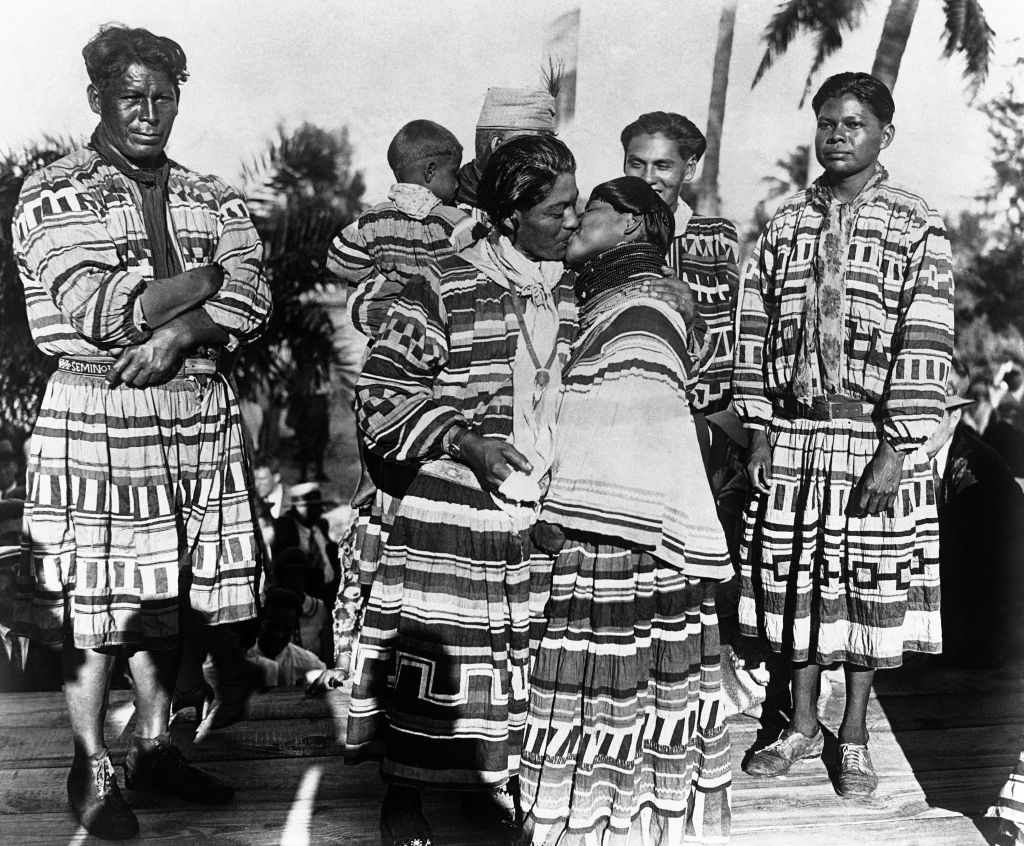
The tiger and otter clans men are naturally taller and physical dominating men. They are said to be very tall and muscular men who have a copper colored tone. In addition, these men have chiseled jaw bones with large heads and beady black eyes and small lips. Being natural born warriors the men of the tiger clan Seminole’s movements are calculated, consistent, and powerful. The Seminole men are known for hunting on foot which has caused them to develop deformities in their foot because of the constant pressure and damage; also they have developed large calves and strong tendons from the same barefoot activities. However, not every Seminole male is built this way, but excluding the few that aren’t the male population is seen as “handsome and exceptionally powerful.” (MacCauley) As for the women of the Seminole tribe they receive similar praise for their outstanding physique. In addition, the as well can endure physical hardships and they have many attractive traits to match their physicality ” I would even venture to select from among these Indians three persons whom I could, without much fear of contradiction, present as types respectively of a handsome, a pretty, and a comely woman. Among American Indians, I am confident that the Seminole women are of the first rank.” (MacCauley)

Seminole Clothing

The Seminole tribe typically wear light clothing due to their lifestyle which consists of mostly cottons, gingham’s, and flannels on a rarer occasion. Moreover, the Seminoles may fashion blankets or shawls to gift them added warmth and most Seminoles do not wear shoes but if they do they will be more than likely moccasins. However, there is much diversity among outfits for these Native Americans according to your position in the tribe. For example the warriors outfits for Seminoles consist of “a shirt, a neckerchief, a turban, a breech cloth, and, very rarely, moccasins. On but one Indian in camp did I see more than this; on many, less. The shirt is made of some figured or striped cotton cloth, generally of quiet colors. It hangs from the neck to the knees, the narrow, rolling collar being closely buttoned about the neck, the narrow wristbands of the roomy sleeves buttoned about the wrists. The garment opens in front for a few inches, downward from the collar, and is pocket less. A belt of leather or buckskin usually the man’s waist, and from it are suspended one or more pouches, in which powder, bullets, pocket knife, a piece of flint, a small quantity of paper, and like things for use in hunting are carried” (MacCauley). The warriors of the Seminole tribe seem to wear thicker clothing to prepare themselves for the harsh weather the may encounter while in war or hunting but to hold the materials and weapons they carry as well. The Seminole women do not wear much more than what the men wear as I believe this is a cultural action. Their outfits most of the time consist of two garments ” one of which, for lack of a better English word, I name a short shirt, the other a long skirt. The shirt is cut quite low at the neck and is just long enough to cover the breasts. Its sleeves are buttoned close about the wrists. The garment is otherwise button less, being wide enough at the neck for it to be easily put on or taken off over the head. The conservatism of the Seminole Indian is shown in nothing more clearly than in the use, by the women, of this much abbreviated covering for the upper part of their bodies. The women are noticeably modest..” (MacCauley)
Citations

Admin. “The Second Seminole War.” Native American Netroots, November 30, 2015. http://nativeamericannetroots.net/diary/2019.

Clay MacCauley (1843-1925). “The Seminole Indians of Florida”, Fifth Annual Report of the Bureau of Ethnology to the Secretary of the Smithsonian Institution, 1883-’84, published by the United States Government Printing Office, Washington, D.C., 1887, pages 469-531. 

Fletcher, Matthew L.M. “The Seminole Tribe and Origins of Indian Gaming.” HeinOnline. Accessed November 16, 2019. https://heinonline.org/HOL/LandingPage?handle=hein.journals/fiulawr9&div=40&id=&page=.

Scallet, Daniel. “This Inglorious War: The Second Seminole War, the Ad Hoc Origins of American Imperialism, and the Silence of Slavery.” Washington University Open Scholarship. Accessed November 16, 2019. https://openscholarship.wustl.edu/etd/638/.

“Seminole History.” Florida Department of State. Accessed November 15, 2019. https://dos.myflorida.com/florida-facts/florida-history/seminole-history/.


Seminole History

Seminole history started in the 1700s in the states known today as Georgia and Alabama. They all descended from the creek Indians which disbanded mostly because of wars and conflicts with European settlers. However, even within the creek Indians there was some disharmony as the lower creek Indians moved to Florida to escape the domination of the Upper creeks. “Some Creeks were searching for rich, new fields to plant corn, beans and other crops. For a while, Spain even encouraged these migrations to help provide a buffer between Florida and the British colonies.”(Seminole history) In the 1770s these lower creek Indians acquired there name as the Seminoles which has a few different translations such as “wild people”, “runaway”, and “unconquered people”. In addition, thus is a well deserved name as they only started with 300 Native Americans who were able to escape the hands of the U.S. army during the 1800s.

Present Day there are more than six Seminole reservations in the state of Florida located in Tampa, Big Cypress, Brighton, Immokalee, and Ft. Pierce. “The Seminoles work hard to be economically independent. To do this, they’ve jumped into a number of different industries. Tourism and bingo profits pay for infrastructure and schools on their reservations, while citrus groves and cattle have replaced early 20th-century trade in animal hides and crafts as the tribe’s primary revenue sources.” In addition the Seminole tribe played a major role in Indian gaming into the U.S. for economical succession. The Seminole tribe also paved the way for tribes in the regulation process for Indian gaming taking legal actions in one of the earliest lower court cases.

Seminole Warfare

The Second Seminole war

 “The nation abandoned older Jeffersonian ideals of national expansion predicated upon ideological conversion and instead embraced violent conquest, without a real debate, let alone a fight. This project has two main focuses. In the first, I examine how disparate people in Florida, including generals, volunteers, soldiers, Seminoles, and Black Seminoles, viewed the war and, through the use of diaries, letters, personal narratives, and professional reports, demonstrate the centrality of competing conceptions of slavery and race relations to the everyday struggles of the conflict. Several times, American generals proposed peace treaties that would allow the Seminoles to remain in southern Florida.” (Scallet)

The second Seminole war started when the American government attempted to relocate the Native Americans of Florida to Oklahoma. During 1880s president Jackson held the power position in the U.S. despite him being part Native American he believed that them living and breathing was one of the biggest threats to the harmony of the American people and heavily desired to see them removed from existence. He has stated that the Native Americans are an inferior race that has neither intelligence, morals, or the ability to evolve. Moreover, President Jackson held a grudge against the Seminole tribe because they helped runaway slaves and gave them food and shelter. Perhaps this was one of the most important contributing factors for the second Seminole war because the Natives were concerned about the well-being of the blacks as they had assimilated to the culture very well and some were even married to parts of the Seminole tribe. When the American settlers began to take action towards enslaving the blacks again that’s when tension started to rise. One of the Seminole leaders had mouth full to say towards representatives of the American government which lead to an huge ambush ” a war party led by Osceola ambushed Charley Emathla, the Seminole leader who signed the removal treaty with the Americans. As a symbolic gesture, Osceola scattered the money Emathla received from the Americans over his dead body. Osceola’s warriors then ambushed Indian agent Wiley Thompson, killing seven of the Americans. Warriors led by Alligator, Micanopy, and Jumper attacked American soldiers near Tampa Bay, Florida and killed 105 of the 108 soldiers. This marks the formal beginning of the Second Seminole War.” ( Admin). After, a couple of battles the Americans chose to make the a piece council which was really a disguise to capture the Seminole leaders while there guard was down. The leader that lead the first ambush Osceola was murdered after being battered and captured. The aftermath was some the Seminoles giving up their territory and the blacks with them being captured and returned back to slavery. However, this did not cease the war ” Most of the battles of the Second Seminole War were guerilla skirmishes in which small groups of Seminole warriors quickly vanished. One of the largest battles of the war was the 1837 Battle of Lake Okeechobee. Alligator, Arpeika, and Wildcat led their Seminole warriors against Colonel Zachary Taylor’s troops. The Americans, with 1,000 soldiers, were under orders to destroy any Seminole force which they met. The American troops were met with well-directed fire from the Seminole warriors. The Seminole warriors had breech-loading Spanish long guns with rifled barrels which meant that they were more accurate and could be reloaded quickly. Taylor’s plan was for his militia to retreat at first fire and then re-form behind the regular soldiers. However, the militia sustained heavy losses and the frightened volunteers broke and ran for their horses, too shattered to re-form. The battle left 26 soldiers dead and 112 wounded. The Seminole casualties included 11 dead and 14 wounded. ” (Admin) the war ended with the United States withdrawing their troops in 1842 when most if the Seminoles relocated to Oklahoma with a a couple of hundred still residing in Florida, but the U.S. government did pay a large total of 40 million dollars for their war efforts.

Design a site like this with WordPress.com
Get started